
Strategic approach
The TN SHORE Project adopts a five-pronged strategic approach:
Integrated and Evidence-Based Coastal Management
The project is rooted in ICZM principles and is aligned with the CRZ Notification (2019), emphasizing ecological zoning, shoreline planning, and integrated resource management. Scientific assessments, geospatial tools, and blue carbon data are embedded across planning and implementation. Restoration and protection activities are guided by shoreline management plans, coastal vulnerability indices, and habitat condition assessments.
Nature-Based and Climate-Responsive Interventions
The project promotes nature-based solutions (NbS) such as mangrove plantations, seagrass rehabilitation, dune stabilization, and coral reef restoration. These ecological buffers will serve as the first line of defense against climate-induced coastal hazards while simultaneously supporting biodiversity conservation and carbon sequestration. The strategic use of blue carbon ecosystems contributes directly to India’s climate mitigation goals and enhances adaptive capacity of communities.
Livelihood Diversification and Coastal Economy Transformation
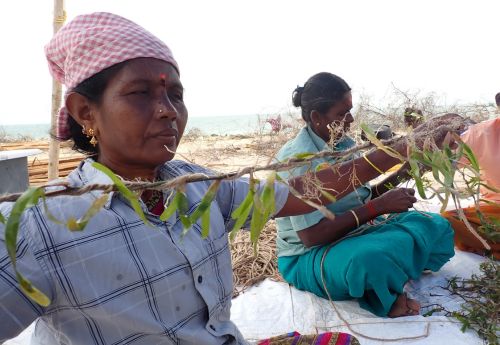
Recognizing the dependency of coastal communities on fragile ecosystems, the project focuses on building economic resilience through skill development, eco-tourism, green enterprise promotion, and improved fisheries-based value chains. Special emphasis is placed on creating opportunities for women, youth, and marginalized groups under a socially inclusive framework. Community-based institutions such as Self-Help Groups (SHGs), Eco-Development Committees (EDCs) and local tourism cooperatives are central to implementation.
Circular Economy and Marine Pollution Abatement
The project addresses marine pollution, especially plastic leakage, by promoting a circular economy model. This includes scaling up the “Meendum Manjapai” initiative, establishing material recovery facilities (MRFs), Discarded Fishnet Collection Centre and Floating Trash boom barriers. The interventions are designed to reduce ocean-bound plastic and improve the health of coastal waters and ecosystems.
Institutional Strengthening, Community Engagement, and Innovation
TN SHORE invests in strengthening institutional capacity at all levels from the State Project Management Unit (SPMU) to frontline departments and district-level functionaries. It supports training, monitoring, inter-agency coordination, and knowledge partnerships. The project also emphasizes participatory planning and grievance redressal, ensuring transparency and accountability. Innovative solutions such as real-time GHG monitoring, marine biodiversity research centres, and ecosystem service valuation tools are embedded throughout the project lifecycle.
This integrated strategic architecture ensures that the TN SHORE Project not only addresses immediate environmental and developmental challenges but also creates a robust foundation for long-term, scalable, and replicable coastal resilience programming across India.