
Coastal Protection
Bathymetry survey and wave dynamics modelling study for design and deployment layout for Artificial Reef Modules
Evidence-based climate governance: The system will replace assumption-based wetland claims with measured evidence on carbon sequestration, methane emissions, cooling and water balance.
Audit-ready data: Instrument-based continuous data will provide objective evidence for CAG, TNGCC Board, World Bank and Government review.
Improved GHG accounting: Tamil Nadu can move towards site-specific wetland emission factors and higher-quality climate reporting instead of relying only on generic default values.
Urban resilience planning: Data on heat, water vapour and energy balance will demonstrate the role of Pallikaranai as natural infrastructure for Chennai’s heat and flood resilience.
Replicable model: The observatory can become the first model for extending real-time GHG monitoring to other Ramsar and coastal wetlands under TN-SHORE.
Key Features
- Establishment of Tamil Nadu's first Wetland Climate Observatory.
- Real-time environmental monitoring infrastructure at Pallikaranai.
- Continuous climate and ecosystem flux database
- Annual assessment of carbon sequestration and emissions.
- Dashboard-based visualization platform for decision makers.
Project Cost: ₹40.00 Lakh
Target Completion: May 2030
Building Bio shields for Habitat Rehabilitation and Mangrove Restoration
- Coastal protection: Establish mangrove and other suitable coastal vegetation as natural barriers against cyclones, storm surges, coastal flooding, erosion and saltwater intrusion.
- Mangrove restoration: Restore degraded and fragmented mangrove habitats through plantation, assisted natural regeneration and habitat improvement.
- Biodiversity conservation: Improve habitats for fish, crabs, birds and other coastal and marine species, strengthening ecological connectivity.
- Climate resilience: Enhance the capacity of coastal communities and ecosystems to withstand climate change and extreme weather events.
- Livelihood support: Improve coastal ecosystem services that support fisheries and other nature-dependent livelihoods.
- Carbon sequestration: Increase blue carbon storage through restoration and expansion of mangrove ecosystems.
- Community participation: Involve local communities in plantation, protection, monitoring and maintenance to ensure long-term sustainability.
Key Features
- To reduce the impacts of coastal erosion and natural hazards.
- To promote nature-based solutions for coastal protection.
- To increase green cover along vulnerable coastal stretches.
- To restore and conserve native coastal vegetation.
- To enhance coastal biodiversity and ecological resilience.
- To strengthen the resilience of coastal communities to climate change.
- To promote community participation in the protection and long-term maintenance of bio shield plantations.
Project Cost: ₹38.29 Crore
Target Completion: May 2030
Enhancing the Coastal Community's Adaptive Capacity to Climate Change Impacts by Protecting and Restoring Kariyachalli Island and the Surrounding Coral and Seagrass Habitats, Gulf of Mannar, Tamil Nadu
The project consists of four major components:
1. Island Protection o Deployment of artificial reef modules around Kariyachalli Island to reduce wave energy, stabilize the shoreline, promote sediment deposition, and enhance marine biodiversity.
2. Coral Reef Restoration o Rehabilitation of degraded coral reef habitats through coral transplantation, artificial substrates, and long-term ecological monitoring.
3. Seagrass Restoration o Restoration of degraded seagrass meadows using scientifically developed transplantation techniques to improve blue carbon storage, fish habitats, and coastal resilience.
4. Community Livelihood Development o Eco-development programmes, including alternative livelihood support, women's Self-Help Group (SHG) strengthening, vocational training, eco-tourism promotion, biodiversity awareness, and fisheries-based livelihood enhancement.
Key Features
- Protection of Kariyachalli Island from further erosion and submergence.
- Restoration of coral reefs and seagrass ecosystems, leading to improved marine biodiversity.
- Increased fish production and strengthened livelihoods for local fishing communities.
- Enhanced climate resilience through nature-based coastal protection.
- Long-term conservation of one of the most ecologically important islands in the Gulf of Mannar Marine National Park.
Project Cost: ₹39.91 Crore
Target Completion: June 2028
Wide-scale Restoration seagrass beds
Wide-scale restoration of degraded seagrass beds and assessment of Blue Carbon potential in Gulf of Mannar, Tamil Nadu
A large-scale ecological restoration initiative to conserve and restore seagrass meadows in the Gulf of Mannar, enhancing critical marine habitats that support biodiversity, fisheries, and blue carbon sequestration. The project focuses on improving coastal ecosystem resilience through scientific restoration techniques and collaborative conservation efforts. 15 acres* across Vilanguchalli, Thalayari, and Hare Island, Ramanathapuram District
Key Features
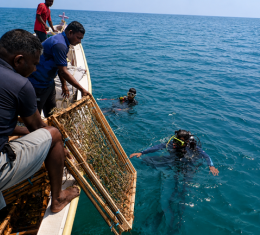
- Restoration of degraded seagrass habitats using 30,000 Casuarina frames for seagrass twig tying
- Enhancement of marine biodiversity and fish breeding habitats
- Strengthening coastal resilience and blue carbon ecosystems
- Scientific monitoring and adaptive restoration practices
- Technical support from the Sugathi Devadason Marine Research Institute (SDMRI) and implementation support by the *Wildlife Warden, Ramanathapuram.
Project Cost: ₹18.01 Crore
Target Completion: June 2028
Proposal for Establishing an Eddy Covariance Flux Tower at Pallikaranai Ramsar Wetland
The project aims to The Eddy Covariance technique is internationally used to directly measure the exchange of carbon, water vapour and energy between ecosystems and the atmosphere. At Pallikaranai, the proposed system will continuously measure: CO₂ flux - whether the wetland absorbs or emits carbon dioxide; CH₄ flux - whether waterlogged, sewage-influenced or degraded patches are methane hotspots; water vapour / evapotranspiration - the wetland’s role in water balance and cooling; heat and energy fluxes - the wetland’s contribution to moderating Chennai’s urban heat; meteorological and soil variables - wind, radiation, rainfall, humidity, temperature, soil moisture and soil temperature that explain flux behaviour.
Key Features
- Evidence-based climate governance: The system will replace assumption-based wetland claims with measured evidence on carbon sequestration, methane emissions, cooling and water balance.
- Better public investment decisions: It will show which restoration actions reduce emissions, improve cooling, enhance wetland functioning and therefore justify continued investment.
- Audit-ready data: Instrument-based continuous data will provide objective evidence for CAG, TNGCC Board, World Bank and Government review.
- Improved GHG accounting: Tamil Nadu can move towards site-specific wetland emission factors and higher-quality climate reporting instead of relying only on generic default values.
- Urban resilience planning: Data on heat, water vapour and energy balance will demonstrate the role of Pallikaranai as natural infrastructure for Chennai's heat and flood resilience.
- Replicable model: The observatory can become the first model for extending real-time GHG monitoring to other Ramsar and coastal wetlands under TN-SHORE..
Project Cost: ₹05.00 Crore
Target Completion: May 2030